The Evolution of the Quaker Book of Discipline Philadelphia Yearly Meeting, 1715-1755
Transcribed and edited with additional materials by David Haines
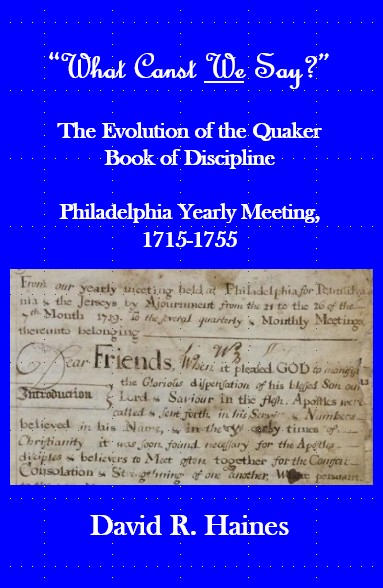
“What Canst We Say?” includes the texts of the various iterations and modifications of the Philadelphia Yearly Meeting Book of Discipline as it evolved between 1715 and 1755. It also includes an examination of the processes by which these developments occurred, including the texts of some Yearly Meeting minutes and publications produced during this time.
Life within the Yearly Meeting during these times involved many aspects which were not dealt with extensively in the Book of Discipline, but which were important to the development of the community and to their identity in the world. Three of these issues (the rules on marriage between relatives, the evolution of the Yearly Meeting on the issue of slavery, and the role of women in the development of the Discipline) are discussed in the Appendices.
The Yearly Meeting was very conscious that it was seeking a document with which the community could develop a deep unity, but also that the attainment of such unity was a process, rather than a declaration of truth. There was full expectation that the contents of the Book of Discipline would be changed, and that asking questions of the current text was a part of the responsibility of the Yearly Meeting community. The documents issued at the completion of several of the sections of the Discipline included statements on how the text was to be used, as well as explanations of how the principles described in the text could be questioned, challenged, and evolved.
- Paperback : 176 pages
- ISBN-10 : 978-0-9979848-4-2
- Dimensions : 6″ x 9″
Reviews
In the longer of these works, “What Canst We Say?” David Haines lays out a two-fold rationale that applies to both books:
The first purpose is to provide an easily accessible source of these texts which are fundamental to our understanding of the origins of the modern Society of Friends in America. Many of the issues included in the early Discipline continue to be of concern to us, while others may now be seen as anachronistic. The reality that we struggled with these issues (such as plain dress and language, the appropriate roles of women in the Society of Friends, and slavery) for so many years, has colored our own and society’s vision of who we are today.
It is essential to understand this, writes Haines, because “progress for a community is rarely linear and is often slow.” This leads him to his second justification. He wants to show not just the conclusions that Friends reached but how and why they reached them. For him “peripheral” issues are as revealing as those that we today find meaningful, for in them “we see all of the human foibles of modern human interactions”: avoidance, denigrating the messenger, false urgency. This history, he concludes, shows that “we have had to learn to have difficult conversations, to live with each other in times when we know that we are not yet in unity, and to make decisions as a community, even when we know that the decisions that we can make now are not the final solutions to the problems that we are seeking to address.”
Review by Tom Hamm
Read the full review at https://www.friendsjournal.org/book/the-first-american-quaker-discipline-philadelphia-yearly-meeting-rules-of-discipline-and-practice-from-1704/
 Pleasant Green Books